
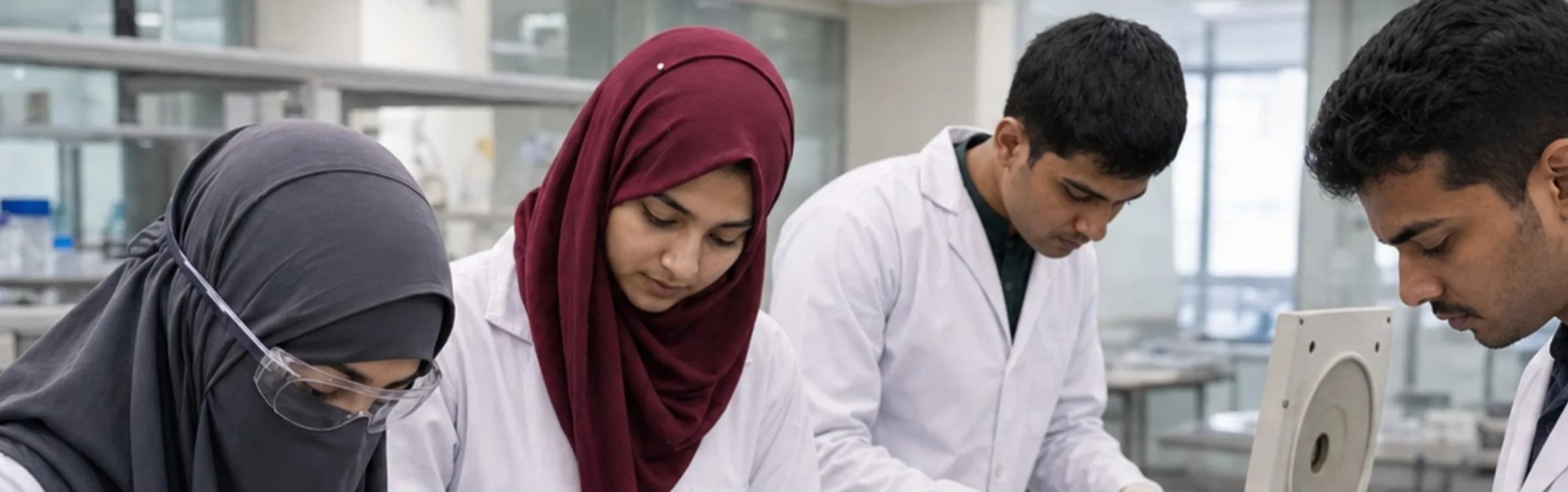
Transforming Biological Knowledge into Scientific Discovery.
Programme
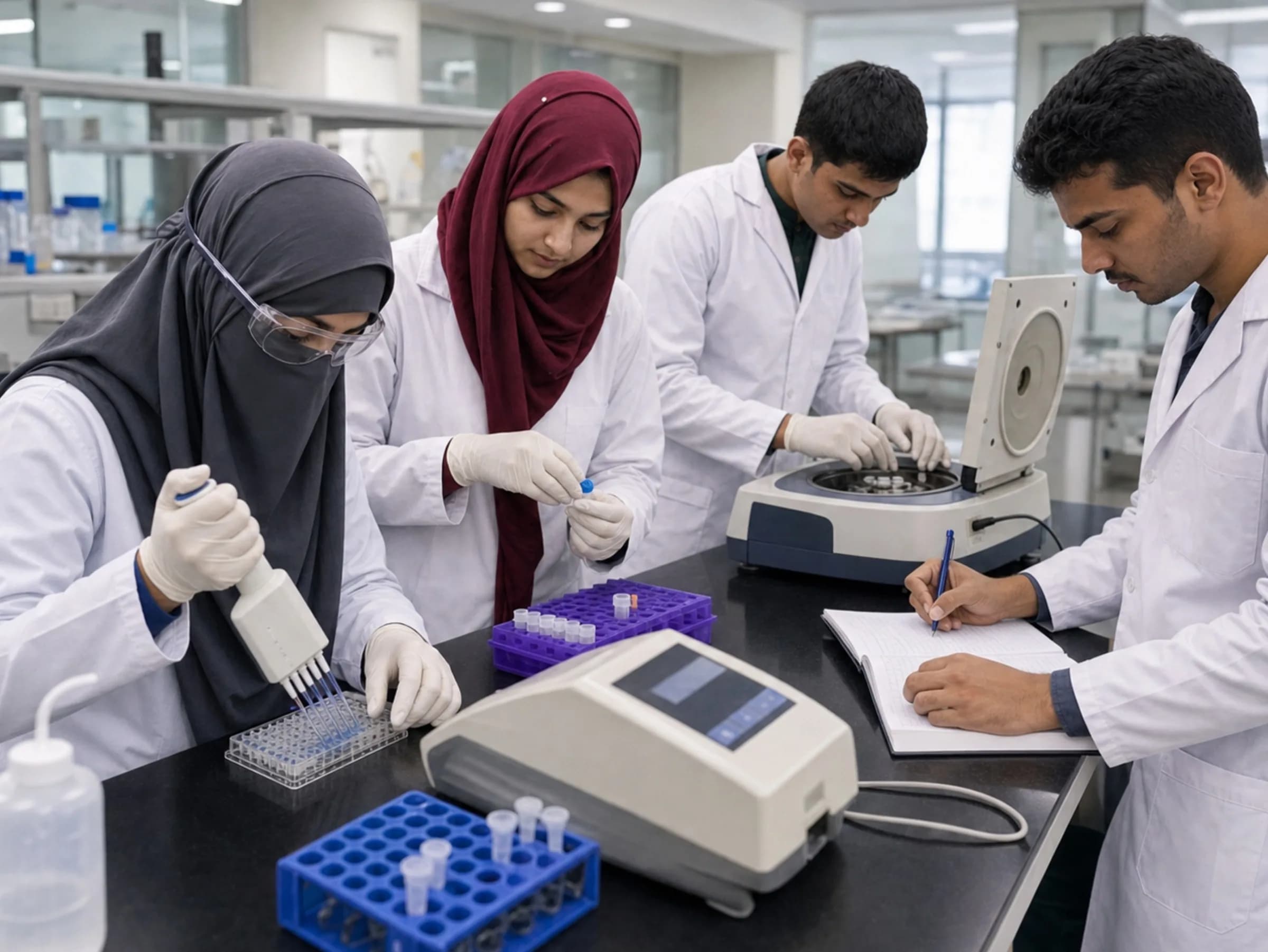
The Department of Biochemistry is committed to advancing knowledge of the molecular mechanisms that govern life and applying this understanding to improve human health and address global scientific challenges. Our program combines a strong foundation in biochemistry, molecular biology, genetics, and biotechnology with hands-on laboratory training and research opportunities, equipping students with the knowledge, technical expertise, and analytical skills needed for careers in healthcare, pharmaceuticals, biotechnology, academia, and research. Through excellence in teaching, innovation, and ethical scientific practice, we prepare graduates to become competent professionals and future leaders in the life sciences.
What you'll gain
Deliver a comprehensive education in biochemistry and related life sciences through an outcome-based curriculum, modern laboratory training, and innovative teaching practices.
Foster scientific inquiry, critical thinking, and research excellence to address challenges in healthcare, biotechnology, agriculture, and environmental sciences.
Prepare graduates with the technical expertise, analytical skills, communication abilities, and professional ethics required for successful careers in academia, research, industry, and clinical laboratories.
Accreditation
Able to understand the basic concepts about the structure and chemistry of biomolecules.
The objective of the Bachelor’s Program in Biochemistry is to prepare students for future careers in the various fields in which a core understanding of the biochemistry of biological processes is important. Scientific disciplines such as human biochemistry, medical biochemistry, and biotechnology will enhance the understanding of human health.
The Biochemistry Program will benefit society on the whole by adding to the highly skilled scientific workforce, particularly for the biomedical research sectors, in the academic, industry as well and for research laboratories across the country and the globe.
The students opting for the Biochemistry program will have an advanced in in-depth understanding of all the human biochemical aspects pertaining to the well-being and in the pathological state.
OBE Framework
| PLO | Mapped PEO | Title | Description |
|---|---|---|---|
| PLO1 | A better understanding of the key principles of biochemical functioning at an advanced level. | ||
| PLO2 | Ability to design and carry out experiments (safely) and to interpret experimental data. | ||
| PLO3 | Production of substantial original research of significance and quality sufficient for publication. | ||
| PLO4 | Ability to present their work through written, oral, and visual presentations, including an original research proposal. | ||
| PLO5 | Awareness of ethical issues in biochemical research and career options. | ||
| PLO6 | Students will construct a research thesis, and present the results of that thesis to an audience of peers and faculty at regional or all-college events, and be able to defend their results to other students and faculty. | ||
| PLO7 | Students will explain/describe the synthesis of proteins, lipids, nucleic acids, and carbohydrates and their role in metabolic pathways. | ||
| PLO8 | Students will use current biochemical and molecular techniques to plan and carry out experiments. They will generate and test hypotheses, analyze data using statistical methods where appropriate, and appreciate the limitations of conclusions drawn from experimental data. | ||
| PLO9 | Demonstrate a comprehensive understanding of fundamental concepts in biochemistry, integrating knowledge across molecular, cellular, organismal and biochemical pathways. | ||
| PLO10 | Effectively use methods and techniques as applied in the field of biochemistry, including analytical, molecular, computational and structural approaches. | ||
| PLO11 | Communicate scientific knowledge and research findings in biochemistry while demonstrating a commitment to continuous learning and professional development in the field. |
Curriculum
Select your admission session to view the exact roadmap. Each session links to the official Scheme of Studies PDF and lists every semester's courses, categories, and pre-requisites.
| # | Code | Course Title | Category | CH | Pre-Req |
|---|---|---|---|---|---|
| 1 | BCH-301 | Introduction to Biochemistry | Major | 3(2+1) | — |
| 2 | CHEM-301 | Inorganic Chemistry | Interdisciplinary | 3(2+1) | — |
| 3 | GEMATH-303 | Quantitative Reasoning I | General Education | 3(3+0) | — |
| 4 | GENS-300 | Biodiversity Conservation and Sustainability | Natural Science | 3(3+0) | — |
| 5 | GEENG-300 | Functional English | General Education | 3(3+0) | — |
| 6 | GEIT-300 | Applications of Information & Communication Technologies (ICT) | General Education | 3(2+1) | — |
Introduction to Biochemistry
Major
Inorganic Chemistry
Interdisciplinary
Quantitative Reasoning I
General Education
Biodiversity Conservation and Sustainability
Natural Science
Functional English
General Education
Applications of Information & Communication Technologies (ICT)
General Education
| # | Code | Course Title | Category | CH | Pre-Req |
|---|---|---|---|---|---|
| 1 | ZOO-352 | Cell Biology | Major | 3(3+0) | — |
| 2 | BCH-350 | Plant Biochemistry | Major | 3(3+0) | — |
| 3 | CHEM-302 | Organic Chemistry | Interdisciplinary | 3(2+1) | — |
| 4 | GEMATH-352 | Quantitative Reasoning – II | General Education | 3(3+0) | — |
| 5 | GEPSY-300 | Introduction to Psychology | General Education | 2(2+0) | — |
| 6 | GEENG-352 | Expository Writing | General Education | 3(3+0) | — |
| 7 | GEISL-301 | Understanding of Holy Quran 1 | General Education | 1(0+1) | — |
Cell Biology
Major
Plant Biochemistry
Major
Organic Chemistry
Interdisciplinary
Quantitative Reasoning – II
General Education
Introduction to Psychology
General Education
Expository Writing
General Education
Understanding of Holy Quran 1
General Education
| # | Code | Course Title | Category | CH | Pre-Req |
|---|---|---|---|---|---|
| 1 | BCH-411 | Carbohydrates & Lipids | Major | 3(2+1) | — |
| 2 | BCH-400 | Human Physiology | Major | 3(2+1) | — |
| 3 | BT-351 | Principles of Genetics | Interdisciplinary | 3(3+0) | — |
| 4 | GE-400 | Ideology & Constitution of Pakistan | General Education | 2(2+0) | — |
| 5 | GEISL-300 | Islamic Studies (Ethics for Non Muslims) | General Education | 2(2+0) | — |
| 6 | PS-301 | Pakistan Studies | General Education | 2(2+0) | — |
Carbohydrates & Lipids
Major
Human Physiology
Major
Principles of Genetics
Interdisciplinary
Ideology & Constitution of Pakistan
General Education
Islamic Studies (Ethics for Non Muslims)
General Education
Pakistan Studies
General Education
| # | Code | Course Title | Category | CH | Pre-Req |
|---|---|---|---|---|---|
| 1 | BCH-451 | Proteins & Nucleic Acids | Major | 3(2+1) | — |
| 2 | BCH-461 | Fundamentals of Molecular Biology | Major | 3(2+1) | — |
| 3 | BCH-452 | Nutritional Biochemistry | Major | 3(2+1) | — |
| 4 | CHEM-405 | Physical Chemistry | Interdisciplinary | 3(3+0) | — |
| 5 | GE-EDU-450 | Civics & Community Engagement | General Education | 2(2+0) | — |
| 6 | GEISL-302 | Understanding of Holy Quran 2 | General Education | 1(0+1) | — |
| 7 | BC-403 | Enterpreneurship | General Education | 2(2+0) | — |
| 8 | PS-401 | Ideology & Constitution of Pakistan | General Education | 2(2+0) | — |
Proteins & Nucleic Acids
Major
Fundamentals of Molecular Biology
Major
Nutritional Biochemistry
Major
Physical Chemistry
Interdisciplinary
Civics & Community Engagement
General Education
Understanding of Holy Quran 2
General Education
Enterpreneurship
General Education
Ideology & Constitution of Pakistan
General Education
| # | Code | Course Title | Category | CH | Pre-Req |
|---|---|---|---|---|---|
| 1 | BCH-511 | Metabolism of Carbohydrates & Lipids | Major | 3(3+0) | — |
| 2 | BCH-512 | Fundamentals of Microbiology | Interdisciplinary | 3(2+1) | — |
| 3 | BT-500 | Immunology | Major | 3(2+1) | — |
| 4 | BCH-523 | Enzymology | Major | 3(2+1) | — |
| 5 | BT-300 | Introduction to Biotechnology | Interdisciplinary | 3(2+1) | — |
| 6 | BCH-501 | Artificial Intelligence | Major | 3(3+0) | — |
Metabolism of Carbohydrates & Lipids
Major
Fundamentals of Microbiology
Interdisciplinary
Immunology
Major
Enzymology
Major
Introduction to Biotechnology
Interdisciplinary
Artificial Intelligence
Major
| # | Code | Course Title | Category | CH | Pre-Req |
|---|---|---|---|---|---|
| 1 | BCH-561 | Metabolism of Proteins & Nucleic Acids | Major | 3(3+0) | — |
| 2 | BCH-563 | Cancer Biology | Major | 3(3+0) | — |
| 3 | BCH-562 | Environmental Biochemistry | Major | 3(2+1) | — |
| 4 | Elective I | Major | 3 | — | |
| 5 | BT-550 | Probability and Biostatistics | Interdisciplinary | 3(3+0) | — |
| 6 | BCH-550 | Scientific Inquiry & Research Methods | Major | 3(2+1) | — |
Metabolism of Proteins & Nucleic Acids
Major
Cancer Biology
Major
Environmental Biochemistry
Major
Elective I
Major
Probability and Biostatistics
Interdisciplinary
Scientific Inquiry & Research Methods
Major
| # | Code | Course Title | Category | CH | Pre-Req |
|---|---|---|---|---|---|
| 1 | BCH-612 | Computational Biology | Major | 3(2+1) | — |
| 2 | BCH-622 | Clinical Biochemistry | Major | 3(2+1) | — |
| 3 | BCH-623 | Analytical Techniques in Biochemistry | Major | 3(2+1) | — |
| 4 | Elective | Major | 3 | — | |
| 5 | BCH-600 | Biosafety & Bioethics | Major | 3(3+0) | — |
| 6 | BCH-633 | Internship | — |
Computational Biology
Major
Clinical Biochemistry
Major
Analytical Techniques in Biochemistry
Major
Elective
Major
Biosafety & Bioethics
Major
Internship
| # | Code | Course Title | Category | CH | Pre-Req |
|---|---|---|---|---|---|
| 1 | BCH-662 | Industrial Biochemistry | Major | 3(3+0) | — |
| 2 | BCH-663 | Genomics, Transcriptomics & Proteomics | Major | 3(3+0) | — |
| 3 | BCH-XXX | Elective III | Major | 3 | — |
| 4 | Elective IV | Major | 3 | — | |
| 5 | BCH-663 | Capstone | Major | 3 | — |
Industrial Biochemistry
Major
Genomics, Transcriptomics & Proteomics
Major
Elective III
Major
Elective IV
Major
Capstone
Major
Admissions
Higher Secondary School Certificate (involving 12 years of schooling) or an IBCC equivalent qualification in any science group with a subject of Biology or General Biology with at least 45% to 50% marks is the basic eligibility requirement for admission in the BS in Biochemistry.
Investment
Your future
The program offers comprehensive knowledge and practical training in diverse fields of modern biochemistry.
Admissions Open
Applications are processed online. Submit your documents, sit the entry test, and track your merit status through the admissions portal.